
AROSAL
Survival of archaea in extreme salinity conditions : new methodological and mechanistic approaches
Scientific responsibility :
- Arnaud Huguet
- Adrienne Kish
- Thierry Dufour
- Vincent Grossi
- Sarah Coffinet
Methodological axes :
Thematic fields :
Disciplinary sectors :
Funding :
- DIM PAMIR
Project ID : IDF-DIM-PAMIR-2026-4-005
Summary :
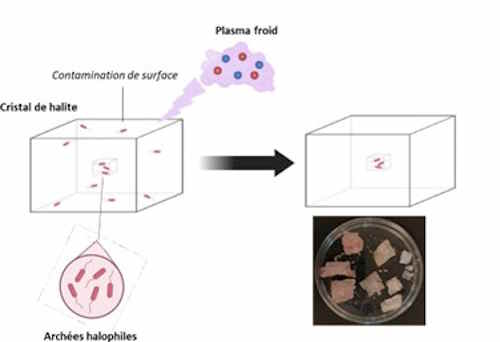
Halophilic microorganisms, living in conditions of extreme salinity, could survive for up to several hundred million years in halite (NaCl) crystals formed after salt evaporation. The study of halophilic microorganisms and associated biomolecules is therefore of interest for the search for traces of past and present life on Earth and other planets. The survival of these microorganisms, such as the archaea Halobacterium salinarum considered here as our study model, requires the development of specific adaptive mechanisms, notably involving membrane lipids. However, currently, there is little information on the membrane adaptation of H. salinarum upon inclusion within halite. The objective of this project will be to develop an innovative cold plasma treatment process for halites to eliminate interfering organic compounds potentially present at the surface of the crystals, and to ensure that the lipids studied are those corresponding solely to H. salinarum cells. This development is a prerequisite for the reliable study of the adaptation mechanisms of the H. salinarum lipidome during the formation of halites. We will then seek to evaluate the role of glycerol and its involvement in the survival of H. salinarum under extreme salinity conditions. This key molecule, produced and released by microalgae present in the same ecosystems as H. salinarum, could help the latter to survive in hypersaline conditions. To investigate the mechanisms and conditions of glycerol assimilation by H. salinarum during halite formation, we will conduct novel isotopic labeling experiments with 13C-labeled glycerol. Our interdisciplinary project, at the interface of microbiology, geochemistry, and plasma physics, will provide key methodological and mechanistic insights into the preservation of lipid biosignatures in halite.
