
JN100
Jemdet Nasr 1926-2026: a Century of Investigation and Research
Scientific responsibility :
- Camille Lecompte
- Hugo Naccaro
- Roger Matthews
Methodological axes :
Thematic fields :
Disciplinary sectors :
Funding :
- DIM PAMIR
- Paris 1 Panthéon Sorbonne – PRISM
- BISI – The British Institute for the Study of Iraq
- ArScAn
- Centre Jaussen & Savignac, Université Paris 1
- University of Reading
Project ID : IDF-DIM-PAMIR-2026-2-005
Summary :
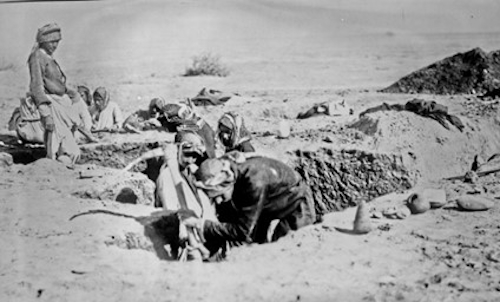
The international conference “Jemdet Nasr 1926–2026: A Century of Investigation and Research” (JN100) will take place in Paris from 2 to 4 June at the Institut national d’histoire de l’art (INHA). The event marks one hundred years since the first excavations were carried out at the site of Jemdet Nasr in Iraq. Located a few dozen kilometres south of Bagdad, this relatively small site yielded discoveries of exceptional importance, securing its place in the history of the ancient Near East. It gave its name to a pivotal chronological phase (ca. 3250–2900 BCE), a transformative period that witnessed the emergence of the earliest writing systems and the rise of the first city-states, at the dawn of recorded history. Research on this decisive stage of Mesopotamian history has remained comparatively limited since the fieldwork conducted by Roger Matthews in 1988–1989, and even more so since the Tübingen conference of 1983—whose published proceedings (Finkbeiner and Röllig, 1986) still stand as the last major synthesis. The Paris 2026 conference will therefore provide a timely and significant opportunity to reassess and advance scholarship on this period. Bringing together the international scholarly community working on this phase, the conference will host twenty-five researchers presenting the latest results from fieldwork in southern and central Iraq, alongside ongoing studies on various aspects of Jemdet Nasr material culture, including ceramics, seals and sealings, and lithic industries. Particular emphasis will be placed on methodological and experimental innovations that have generated important new data on patterns of production, use, and circulation of artefacts, as well as on the history of collections and the discoveries made during the 1926–1928 excavation campaigns. Special attention will also be paid to textual sources and clay tablet archives, written using cuneiform script, more specifically its earliest form known as proto-cuneiform, which reveal the composition of these ancient societies, their hierarchy, and their economic system. The conference will represent a major milestone in international research on the emergence of early writing and the first city-states in Mesopotamia. The publication of its proceedings is expected to become a key reference for scholarship in the decades to come.
