BRONZEDATA
European infrastructure for analytical data on prehistoric copper artefacts
Scientific responsibility :
- Céline Tomczyk
- Thomas Huet
- Christophe Petit
Methodological axes :
Thematic fields :
Disciplinary sectors :
Partnership :
Funding :
- DIM PAMIR
- Trajectoires
Project ID : IDF-DIM-PAMIR-2026-9-001
Summary :
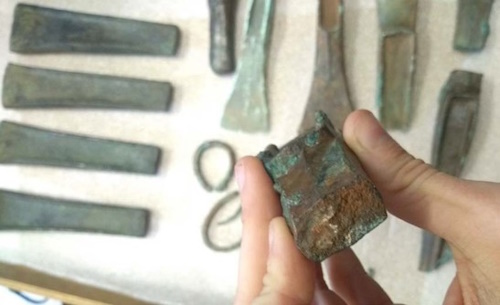
Over the past forty years, research on prehistoric metal production has generated a considerable volume of analytical data, including elemental compositions and isotope analyses. However, these data remain widely scattered across the scientific literature, are reported in heterogeneous formats, and are rarely structured according to common standards, limiting their comparison and reuse. The BRONZEDATA project aims to establish an interoperable reference dataset for analytical data on prehistoric copper-alloy objects, initially focusing on the Paris Basin before expanding to a European scale. In accordance with the FAIR principles, Open Science standards and Semantic Web approaches, it will link analytical results with archaeological and typological data, measurement protocols and bibliographic references, thereby facilitating data discovery, comparison and reuse. The project will be based on: (1) the production of more than 280 new analytical datasets (elemental composition and lead isotope analysis) for Bronze Age copper artefacts held in collections in the Île-de-France region, which are as yet very poorly documented; (2) their integration into the CHIPS interface, their publication as open access in a data paper (presenting the dataset) followed by a research paper (presenting hypotheses regarding the provenance of the copper); (3) the gradual integration of a corpus already comprising more than 9,000 lead isotope analyses in order to extend the repository to a European scale. Building BRONZEDATA upon CHIPS will make it possible to draw on an existing infrastructure designed for data exchange and interoperability, notably through REST APIs. BRONZEDATA will therefore be directly accessible to the scientific community and will progressively develop into a European reference resource for investigating exchange networks during later prehistory.
