
IMAREN-LB
The imagery of the reindeer among Late Paleolithic societies: styles and media of reindeer figures—the emblematic case of Laugerie-Basse
Scientific responsibility :
- Eric Robert
Methodological axes :
Thematic fields :
Disciplinary sectors :
Partnership :
Funding :
- DIM PAMIR
Project ID : IDF-DIM-PAMIR-2026-10-010
Summary :
This internship aims to analyze the role of reindeer in Late Upper Paleolithic societies through the lens of their representations. The central question concerns the symbolic significance of this species within the collective imagination of societies living between 17,000 and 14,000 cal. BP, thereby contributing to current research regarding the redefinition of human-animal relationships during this period. The reindeer was a key species for both subsistence and tool production, dominating the faunal assemblages of the Western European Paleolithic. While rare in cave art, it appears frequently in portable art, particularly during the second half of the Magdalenian period. It thus appears that the reindeer’s symbolic importance increased as its habitat shrank toward the end of this period, prior to the warming of the Holocene. The internship objectives include cataloging and analyzing representations, media, styles, and thematic associations by compiling databases and characterizing the materials used (antler, bone, stone). Work will also involve creating new tracings of pieces from the Laugerie-Basse collection at the National Museum of Natural History, complemented by an inventory of items held at the National Archaeology Museum and the National Museum of Prehistory. The component of the project dedicated to supports made of hard animal materials will involve an archaeological analysis capable of identifying the species and the anatomical position, in order to closely examine the choices made and the connections between the supports and the representations.
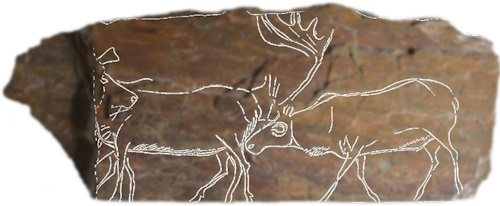
Legend: Engraved plaque known as “The Reindeer Fight,” Laugerie-Basse, MNHN collections. Based on a photograph by L. Glemarec, MNHN, and a modified selective survey by G. Tosello
