
POLA
Chemical composition of Polaroid peel-apart prints by vibrational spectroscopies
Scientific responsibility :
- Céline Daher
Methodological axes :
Thematic fields :
Disciplinary sectors :
Partnership :
Funding :
- DIM PAMIR
Project ID : IDF-DIM-PAMIR-2026-10-013
Summary :
In 1948, Edwin Herbert Land introduced the first black-and-white instant-developing photograph: the Polaroid. These prints, or instant photographs, are based on a technical process involving the diffusion and transfer of silver salts between a negative and a positive that are brought into contact within a specialized camera. There is a wide variety of “types” created by the Polaroid Corporation between 1948 and the early 2000s, which differ in terms of their technology (peel-aparts or integral films), format (roll/pack/sheet) and dimensions, tone (neutral black-and-white or sepia, color), and sensitivity. Very little information exists regarding the chemical composition of these complex multilayer objects and how they evolve depending on storage or exposure conditions. The objective of this internship is to advance our understanding of these renowned prints by studying their multilayer chemical composition using Fourier-transform infrared and Raman spectroscopies. This study will focus on a selection of black-and-white and color Polaroid peel-apart prints from the CRC collection.
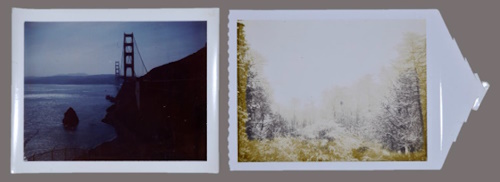
Legend: Polaroid peel-apart prints, types 108 and 47
