
METOIL
Copper-based siccatives in historical oil paintings: a comparison with lead-based systems and their influence on drying and film ageing
Scientific responsibility :
- Laurence de Viguerie
Methodological axes :
Thematic fields :
Disciplinary sectors :
Partnership :
Funding :
- DIM PAMIR
Project ID : IDF-DIM-PAMIR-2026-10-011
Summary :
From the late Middle Ages onwards, painters developed various practices to modify the properties of drying oils and accelerate their drying. Historical recipes mention the use of metal-containing compounds, including copper compounds and, in particular, copper acetate (verdigris). Their use is documented or suspected in paintings ranging from the earliest oil paintings of the Renaissance to later works, including paintings by Vermeer. Yet their influence on the drying and ageing of oil paint films remains poorly understood. This internship aims to reproduce several historical recipes involving copper compounds and to investigate their influence on the formation and evolution of oil paint films. Oils prepared according to these recipes will be applied as model films, with or without pigments, and compared with reference systems containing lead-based siccatives. Their microstructure will be investigated using scanning electron microscopy (SEM) and transmission electron microscopy (TEM). In parallel, drying and light-induced ageing will be monitored in situ using the LAMS photodegradation platform, combining UV-visible, FTIR and near-infrared spectroscopy. These approaches will allow the chemical transformations of the binder to be related to changes in film microstructure and will provide a direct comparison of the effects of copper- and lead-based siccatives.
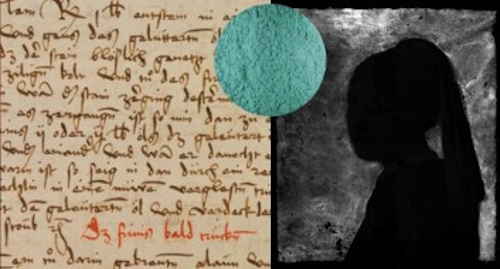
Legend: A. Vandivere, Heritage Science, 2019; image on the right: XRF mapping of the copper in Vermeer’s ‘Girl with a Pearl Earring’
