
MICMAC2
Corrosion inhibition mechanisms of copper metals: from fundamental understanding to on-site application of doped sol-gel treatments
Scientific responsibility :
- Delphine Neff
- Marc Maleval
- Laurent Mugherli
- Barbara Laïk
- Junsoo Han
- Julie Schröter
- Diana Da Silva
Methodological axes :
Thematic fields :
Disciplinary sectors :
Funding :
- DIM PAMIR
Project ID : IDF-DIM-PAMIR-2026-4-020
Summary :
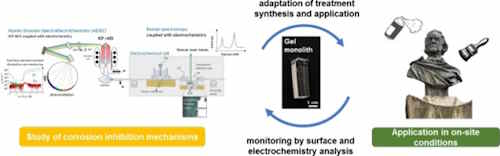
The protection of copper-based metals in cultural heritage requires taking into account the presence of a corrosion product layer (CPL) which is an integral part of the object. Protective corrosion treatments must therefore be applied to this layer and ensure the protection of metal/CPL system. The objective of this project is to develop an innovative protective treatment based on an inhibitor doped sol-gel process that is non-toxic and suitable for heritage objects. The interdisciplinary project has a dual objective: to understand the mechanisms of inhibition acting on CPLs and to transfer laboratory-developed formulations and protocols to field applications in conservation workshops or outdoor environments. It relies on an interdisciplinary partnership involving five entities, including physicochemical laboratories and conservation/restoration workshops, and follows a methodology structured around three research axes. The study will involve laboratory-prepared model samples, metal coupons exhibiting naturally aged corrosion layers, and original corroded cultural heritage artefacts. Axis 1 aims to establish, under laboratory conditions, a method for evaluating the protective mechanisms of the targeted treatments based on the innovative use of electrochemical cells coupled, on the one hand, with Raman spectroscopy to characterize the evolution of the treated CPL, and on the other hand with Atomic Emission SpectroElectroChemistry (AESEC) to analyze the species released into solution. Axis 2 aims to develop synthesis and application protocols that are compatible with field constraints in conservation workshops and on outdoor sites. Finally, axis 3 will develop and implement an on-site monitoring protocol to assess the evolution of the protection through physicochemical and electrochemical measurements carried out on a treated artwork.
Legend and credits
Schematic diagram of coupled Raman/ICP-AES electrochemical cells, modified based on two articles: B. Sultan, O. Gharbi, K. Ogle, J. Han, Curr. Opi. Electrochem., 2023, 41:101350; S. Grassini, M. Parvis, M. Bouchar, P. Dillmann, D. Neff, IEEE Inter. Ins. & Mea. Tech. Conf., 2013, 900–995
Photograph of the bust: Elysa Letouzey
Schematic diagram of coupled Raman/ICP-AES electrochemical cells, modified based on two articles: B. Sultan, O. Gharbi, K. Ogle, J. Han, Curr. Opi. Electrochem., 2023, 41:101350; S. Grassini, M. Parvis, M. Bouchar, P. Dillmann, D. Neff, IEEE Inter. Ins. & Mea. Tech. Conf., 2013, 900–995
Photograph of the bust: Elysa Letouzey
